

A low-dose CBD capsule that helps people sleep could be the catalyst for a rocketing share price and soaring company valuation, and ultimately result in a takeover that will provide a payday for shareholders, the chief executive of Avecho Biotechnology has predicted.
Outlining a vision for the company, Dr Paul Gavin compared Avecho to another ASX-listed biotech, Dimerix, whose successful trial in 2023 for a product targeting kidney disease was the launchpad for huge financial growth.

Avecho is following the same path with its phase III CBD trial for insomnia, he said.
Speaking during an investor briefing after securing an Australian licensing agreement with Sandoz, Gavin said upfront funds of US$3 million provided by the pharmaceutical giant will end concerns that Avecho has insufficient finances to reach the critical interim analysis stage of the trial.
“The market can stop worrying whether we can complete the trial or not,” he said. “Those fears have been allayed. It’s now down to whether the trial works.”
Should its synthetic CBD capsule show it can alleviate insomnia – interim analysis is expected in early 2026 after the remainder of trial participants are recruited and dosed this year – the rewards will quickly flow, he said.
“We are going to be walking a path very similar to another Australian biotech, Dimerix,” Gavin said.
Following successful initial analysis of its trial drug, and agreeing regional licensing deals, Dimerix’s market capitalisation of $26m rocketed to around $336m in 12 months, he told investors.
“Suddenly, everyone started to take notice. We are entering a very similar window of opportunity. We are right at the start… but it’s only a matter of time before the share price re-rates.”
Despite admitting the Avecho share price had not risen as much as anticipated on the back of the Sandoz deal – partly because people did not release the significance of the agreement, he suggested – Gavin insisted it was only “delaying the inevitable”.
With Sandoz in its corner, it has a partner with a solid reputation, deep knowledge of over-the-counter medicines and experience in drug registration procedures with the Therapeutic Goods Administration (TGA), he said.
“Reputation matters in this industry… and we wanted a partner who takes Australia seriously,” Gavin said. “If the interim analysis goes well, with Sandoz on board and with their regulatory expertise, the first thing we’ll do is wrap up the data with a bow and march to the TGA for a chat.
“With Sandoz behind us, there is a scenario where the trial works well enough for the TGA to say that’s probably enough data, let’s call it complete. That’s the scenario we’re pushing towards.”
In the event of promising, but inconclusive, results from the analysis, Avecho will recruit more patients in a bid to achieve the necessary outcome. If it’s clear the capsule has failed to work, the trial will be shut down “to save shareholder funds”, he said.
During the presentation, Gavin made it clear that the real opportunity for Avecho in manufacturing a CBD capsule for insomnia lay in licensing agreements outside of Australia.
The US pharmaceutical market is around 30 times the size of Australia, he said, with Europe and China 20 and 1o times the size respectively.
Sandoz has first right of refusal to match any licensing bid for regions outside of Australia.
“The first deal is always the hardest. There is extensive due diligence, they crawl through everything in the data room, but we now have commercial validation from a very large multinational pharmaceutical company,” Gavin told investors.
He said the Australian deal will form a “benchmark for future licensing agreements”.
“It’s 1o0% the first point, in future licensing discussions, to say ‘I got $3m from Australia, I’d be looking for $90m from the US’. That’s where the deal making starts.”
Asked whether trial success could lead to the company being acquired, Gavin said it was “a definite possibility”.
Any firm signing a licensing deal would likely look “very quickly” at an acquisition rather than paying tens of millions in royalties each year, he suggested.
“This sets us up for the future and these are all possibilities on the table. Either way, shareholders will win.”
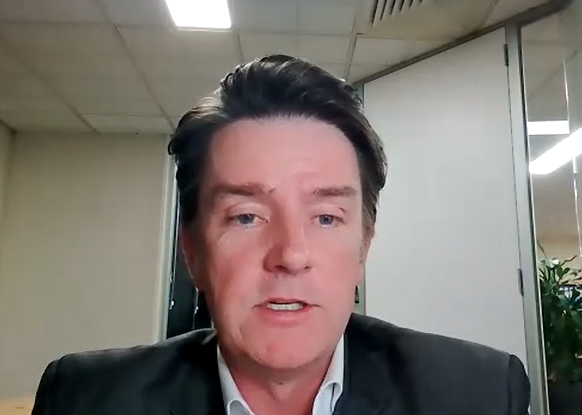
Gavin estimated the cost of the CBD capsules could initially be as much as $200, largely due to the cost of the active pharmaceutical ingredient. But that would “very rapidly” decrease as the API is manufactured at commercial scale.
Gavin also predicted the market would extend beyond those suffering from insomnia and appeal to people with anxiety and “broader mental health indications”.
“The thing about this indication is that insomnia is a gateway to other indications,” he said.
“You can treat depression and anxiety by just helping your patients sleep better. It’s a vicious cycle because if you can’t sleep, your depression becomes worse and when depression becomes worse, you can’t sleep.”
Gavin added it was also highly likely that Avecho and Sandoz would have first-mover advantage in the OTC CBD market for “many years” in Australia given the difficulties in proving efficacy and registering a product with the TGA.
Even if Avecho is successful in registering a product, Gavin said there is “no chance” that a glut of others will follow.
“As we’ve seen with other medicinal cannabis companies that have tried, this is not easy. Phase III trials are hard and commercial development is hard,” he said.
Gavin predicted an OTC product would result in fewer people visiting their doctor for a prescription, arguing it will be far easier to walk into a pharmacy to buy the product than booking and paying for a consultation at a clinic.